
These are our shorter Biographical portraits which we would like to extend if you can provide information or memories.
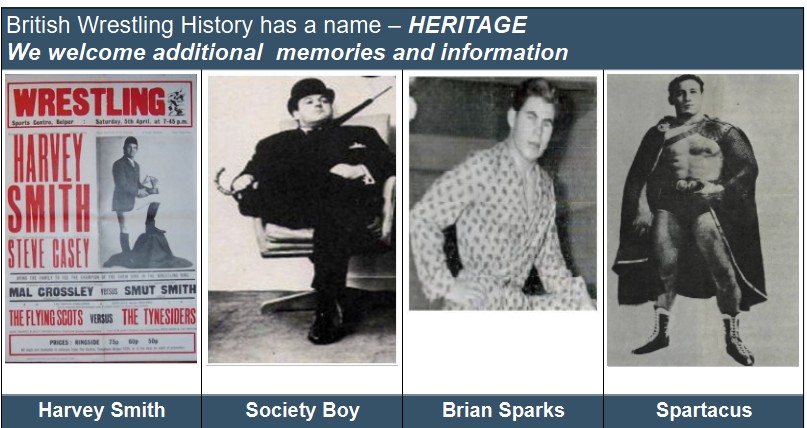
Harvey Smith
It’s true. The world famous show jumping champion Harvey Smith made it into our wrestling rings in the 1970s. And he wasn’t bad. At least the fans appreciated him., entering the ring wearing a large “V” on the back of his velvet robe, a reference to an incident of some notoriety during his show jumping days. . A frequent opponent of Peter Kaye, Harvey would ride him cowboy as though it was the Horse of the Year Show! Another famous opponent was Jackie Pallo. Following a match between the two colourful characters at Blackburn Harvey was left nursing a black eye. The national press loved it, with stories vowing Harvey’s promised revenge. It wasn’t just the press that loved it. Harvey too relished the moment according to Pallo’s son, Jackie Junior.
Although we do not generally favour others cashing in on their personality status by taking up wrestling Harvey did seem to have the guts, strength and character to make him a worthwhile addition to our rings.
Peter Smith
Our entry for Peter Smith is minimalistic to say the least, little more than a plea to find out more about this wrestler who we felt deserved greater attention. Our knowledge is no more than a memory of a wiry lightweight from Newark, who worked for the independent promoters in the 1960s and 1970s. We first came across Pete Smith on a bill in Spilsby in 1961 and during the 1960s working mostly for Jack Taylor, which leads us to think he may have been a member of Taylor’s stable of wrestlers. Reports say that he was cast in the mould of George Kidd. In 1970 Pete won an independents version of the European Lightweight championship (independent promoters) when he defeated Tony Cortez in one of his local halls, the Sports Centre at Balderton. Then he disappeared from our radar. We would like to know more.
Gerda Snyder
Gerda Snyder was a talented female wrestler who worked for independent promoters, mostly Jack Taylor, in the 1960s. She was the sister of wrestler Chris McManus.
Society Boy
Dressed to impress, Society Boy (otherwise Brian Craig-Radcliffe) entered the ring wearing bowler hat and umbrella. Here was another Paul Lincoln creation, oft time tag partner of the Wildman of Borneo, who was a regular feature on independent shows until signed up by Joint Promotions in the autumn of 1964. In the early 1960s he was a familiar figure in Spanish rings, both as a wrestler and as manager of the Wildman of Borneo. We were told of his previous success “in the city,” but assume that was all part of wrestling’s mumbo jumbo. We are more inclined to believe an early interest in rugby and member of the Saracens rugby union team. A tough and rugged seventeen stoner, and stronger than most heavyweights, Brian’s lack of respect for the rules did little to endear him to the fans of the 1960s.
Demon” Al Solak
We didn’t see him but guess a clue lies in the nickname. 1960s worker for the independents, and most likely one of the Jack Taylor men because Mick Collins remembers him often working on Jack’s and Lew Phillips shows. Opponents included Roy LaRue, Ken Davies, Bill Workman, Worked throughout the 1960s but seems to have disappeared around 1970.
Brian Sparks
The “Essex teenage idol” was a popular youngster of the late fifties and early sixties. It was hardly surprising that Brian turned to professional wrestling as he was the son of Charlie Fisher, one of the great wrestling family of seven grappling Fisher brothers He made his professional debut in 1958, combining grappling with studying. Whilst a student at London University Brian’s studies took him to Los Angeles State College where he continued to train and it was said he even worked out with Lou Thesz, Dick Hutton and Buddy Rogers. He seemed destined for success, appeared on television in 1964, but disappeared from the rings of Britain in 1965.
Spartacus (Also known as Jacques Pecheur)
Another Gaulic heavyweight invader. Beneath the gladiatorial costume was the champion French Body builder and wrestler, Jacques Pecheur. He visited the UK in the early 1960s, impressively making his ring entrance dressed as a Roman Slave. Made his first visit, for northern promoters, in 1962; returned for the independents in 1963; and made his first visit to southern Joint Promotions rings in 1964. In 1971 he made a fleeting visit to Britain using the name Jacques Pecheur, losing in the opening round of the 1971 Royal Albert Hall tournament to Mike Marino. Following his retirement Jacques Pecheur .went on to work in films and as a bodyguard for the rich and famous.
Steve Speed
It was a relatively short career for Steve Speed, a muscular fourteen stoner from Brockworth in Gloucestershire. Having developed an interest in physical culture as a teenager he turned his attention to wrestling. Stephen dropped the family name of Trinder, as did his brother who wrestled as Paul Power. Steve made his debut in the early 1980s, still a teenager having been born in 1962. Notable opponents included Danny Collins, Richie Brooks, Kid McCoy, Greg Valentine and Alan Dennison, against whom he made his television debut in December, 1983. Further televised contests were against Steve Grey, Kid McCoy, Richie Brooks, and a tag match partnering Danny Collins against Derek Collins and Pete Lapaque. Despite a complete recovery from a car crash in 1988 recurring back problems brought Steve’s career to a premature end in December, 1989. Two years later we found reference to a comeback match, but are unaware of further appearances.
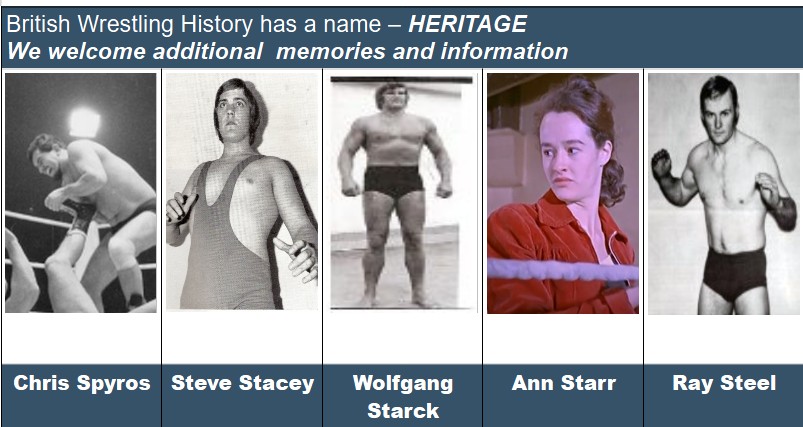
Chris Spyros
Greek mid heavyweight visited Britain between 1964 and 1965,coming to Britain with an allegedly impressive record in India, Australia,, Egypt and Malaya. Maybe, but when meeting an impressive array of British based mid heavies and heavies he seemed to frequently lose to them.
Steve Stacey
Welterweight from Witham in Essex turned professional when he was sixteen years old, working for the independent promoters in the 1970s. Steve was featured in the March, 1972 edition of the Wrestler magazine and was said to be a seed salesman from Witham, Essex. Russell Plummer said he was a future star. We didn’t hear anything more of him. Or did we?
There was a striking resemblance between Stave Stacey and Steve Casey of Boston, who made television appearances in 1981 and 1983. Could they be one and the same person? We would very much like more information.
Johnny Stafford
We would like to learn more about Mancunian Johnny Stafford. Weighed around 12 stones, Johnny worked around northern England in the 1940s. Said to have been the first opponent of Danny Flynn in the late 1930s the first time we find him wrestling was in 1943, disappearing from our rings in 1950. Opponents included Terrence Ricardo, Ted Betley and Alf Kent. Johnny Stafford wrestled at the big wrestling halls of the north and midlands, including Belle Vue, Manchester, Liverpool Stadium and Madeley Street Baths.
Wolfgang Starck
The stylish German heavyweight with American citizenship made a good impression on British fans during his visits spanning 1967 to 1970. His methodical textbook style and some rather nifty high flying manoeuvres made a pleasing contrast to the majority of imported heavyweights. Certainly not invincible the popular German matured over time and visibly improved over successive tours, which tended to be southern biased. Notable achievements included three scalps in one night at the Royal Albert in April 1968, cutting through Count Bartelli, Professor Adiwasser and Jim Hussey to take the Royal Albert Hall in his place. Drawn verdicts at the same venu against both of the top masked men of the time, The Outlaw and Kendo Nagasaki, cemented his popularity at the Kensington venue. At other times results were more mixed, surprisingly being held some midcarders on occasions and suffering straight falls defeats against Mike Marino and Billy Robinson. Wolfgang was the son of Rudi Saturski who had held Mike Marino to a draw at the Royal Albert Hall in 1956.
Ray Steel
The lanky, blond haired light heavyweight was a popular addition to the wrestling circuit when he made his debut on 3rd June 1969, knocking out Dennis Savage at the Eldorado Stadium, Edinburgh.
There was never any likelihood of Ray being labelled as “flash” but his technical skill and agility for a man of his size did give him a certain kind of flair. His methodical, technical style was respected more than loved by fans.
To his not inconsiderable credit Ray’s skill did bring a much needed credibility to the wrestling rings of the 1980s when it was much needed. He was rewarded with the British heavyweight title which he held from 1985 until 1986.
Ray, who learned to wrestle at the Leeds Athletic Institute, turned professional after a successful amateur career, winning a British light heavyweight title. A few more of Ray Steel’s calibre may have maneouvred professional wrestling away from its suicidal tendencies of the 1980’s
2067
 Wrestling Heritage