
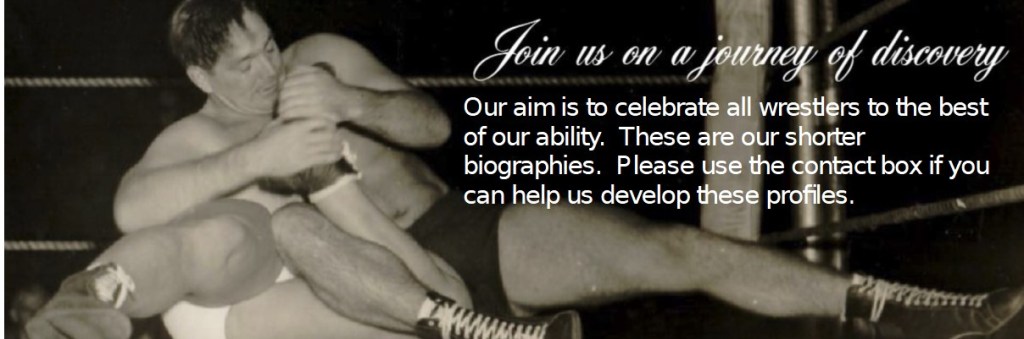
These are our shorter Biographical portraits which we would like to extend if you can provide information or memories.

Bill Warner
Chatham’s Bill Warner survived a world war two prisoner of war camp and an 800 mile trek through Germany to take his place in British wrestling rings as a light heavyweight in the post war revival.
Born in Chatham on 15th December, 1918, Bill Warner became interested in wrestling and joined the Luton Amateur Wrestling Club when he was sixteen years old. At the outbreak of war Bill was working as a bricklayer and enlisted with the Royal West Kents as soon as the conflict began. In 1940 he was captured by the Germans. He endured the prisoner of war camp for five years, weighing just seven stones when the camp was liberated, a story re-told many years later on BBC Radio Kent. On his return to the United Kingdom Bill pursued his career as a professional wrestler. Our last recorded match/ We have found him wrestling from 1947 onwards, opponents including Sonny Wallis, Charlie Fisher and Jack Beaumont. Our last sighting of Bill was in 1951. His interest in wrestling continued, opening a gymnasium in Gillingham, with Alan Kitto and Tony Bates amongst his proteges. Bill Warner died in May, 2001, aged 82.
Earl Warwick (Also known as Tony Royal)
Tom Gaddas was born in Stockton on Tees in 1933. A carpenter by trade the man with the brown curly hair was known to the wrestling fans of northern England as Earl Warwick and Tony Royal. Trained by Jim Stockdale at his gymnasium in Stockton. He and his wife, Audrey, are the parents of actor James Gaddas.
Eric Wasburg
Franco-Finnish wrestler visited Britain in 1957 and 1959, working for Joint Promotions, mainly in the midlands and north of England. First rate opponents included Bob Archer O’Brien, Ken Joyce and John Foley. He did venture south, in February 1959, to face Cliff Belshaw at the Royal Albert Hall. He returned twice more, in 1961 and 1962, this time working for Dale Martin Promotions in the south of England.
Bert Split Waterman
Bert Waterman is included more for what we don’t know than what we do. The name was raised years ago in wrestling forums with the name being linked with speedway star Split Waterman, raising the question of whether they were one and the same. We were able to dispel the myth. We found the name Split Waterman on a bill for the first time in January, 1959, working for Black Butcher Johnson at Walsall Town Hall. There were many appearances for various independent promoters for the following six years, our last sighting of Bert being in August 1965 against Jon Cortez. Other opponents included Bobby Barnes, Zoltan Boscik, Leon Fortuna and Reg Trood.
Trouble arose in January, 1961. Frankie Price advertised Split at the Baths Hall. Ilford as an “ex speedway star.” Newspapers reported hundreds of disappointed speedway fans who had made a special journey expecting to see their speedway hero. Speedy Split took out a writ alleging misrepresentation. Wrestler Bert said that he had been known as Split for around five years and never claimed to be a speedway rider. Any negative impact on his wrestling career was limited as the name remained on the posters (minus any speedway reference) until the mid 1960s.
Whipper Billy Watson
Many fans of the 1960s will remember reading of the exploits of Whipper Watson in those American magazines that arrived in our shops weeks after their publication. He was another of those larger than life characters that existed in the same distant world as other greats such as Lou Thesz, Bruno Sammartino, Freddie Blassie and Gene Kiniski. Most of us were probably ignorant of the fact that this American superstar had spent his formative professional wrestling years learning his trade in the All-In rings of Great Britain.
Canadian by birth as William Potts, born in Toronto, he was brought to Britain in July 1936 by Harry Joyce (father of Doug and Ken), and during his first week faced Tony Baer, Tony Mancelli and Al Korman. His specialism Irish Whip move quickly led to Billy Watson becoming Whipper Watson. Billy wrestled his way around Britain for four years until shortly after war was declared in September, 1939. He returned to Canada to become one of North America’s most popular wrestlers and National Wrestling Alliance World Heavyweight Champion. Whipper Watson retired in 1971, and died at his home in Florida on 4th February, 1990.
Billy Watson Jr
Nearly forty years after his famous wrestling dad, Whipper Billy Watson, had toured Britain, twenty one year old Billy Watson Jr came to Britain during the winter of 1970-71. Billy Jr was born Phil Potts, but the family had long ago changed legally changed their name to Watson.
He was much lighter than his father, barely a middleweight, facing newcomers such as Steve Young and Tony St Clair as well as more experienced opponents that included Jackie Pallo and Colin Joynson. Tagged with fellow Canadian Red Pollard who visited Britain around the same time. His tour ended suddenly at the end of January, resulting in his planned main event contest against Mick McManus at the Royal Albert Hall being cancelled.
Leo Wax
Leo Wax was an Australian boxer with around 130 professional fights to his credit, having boxed in Australia, New Zealand, USA, Denmark and Sweden before arriving in Britain as a boxer in 1929. It clearly suited him because he stayed here. With 67 boxing matches in Britain alone he was a well known name to British wrestling fans. As he neared his thirtieth birthday and wresting booming in Britain Leo became interested in the sport and by 1934 was mostly familiar to wrestling fans, with Jack Dale and Mario Magisti regular opponents. Along with more famous wrestling personalities Jack Pye, Bob Gregory, and King Curtis he appeared in the 1936 film “All In. After finishing with wrestling we have been told Leo managed a night club in London. In 1938, fourteen years after leaving his home in New South Wales, Leo returned for one last boxing match. One match too far as he was knocked out in the first round by Jack Wilson. Following the Second World War Leo settled in Sweden.
Mark Wayne
Present day fans simply could not believe what it was like back in the 1960s and 1970s. In Greater Manchester alone there could be as many as half a dozen shows taking place on the same night, wrestlers often jumping in a car to work on two or three shows a night.
Not all shows were in the big venues like Belle Vue, the Free Trades Hall and the Houldsworth Hall, but in just about every working man’s club, social club, even school hall.
One of those busy, and popular wrestlers from those days was young Mark Wayne of Eccles, a trainee from the Hollywood AWC and contemporary of Eddie Rose,Pete Lindbergh, Ian Wilson and Bob Francini.
When the Hollywood Club closed down Mark’s career almost came to a premature end, until he was taken on by Jack Atherton for training at the Wryton Stadium. The Sunday morning sessions at Wryton Stadium, with old timers like Alf Cadman showing him the ropes led a progression from the independent halls to Joint Promotions in the summer of 1969, and regular work from Jack Atherton and Best Wryton Promotions.
Mark was a very popular welterweight, nicknamed Prince Charming by his colleagues. He gained a lot of work in the early 1970,s but his promising career was cut short by injuries sustained in a road accident. He left wrestling to concentrate on a singing career on the club circuit.
Dave Webb
Another of those skilful workers who were enjoyed in the independent rings of the 1960s and 1970s yet never hit the national limelight. Dave Webb was trained by Stockton’s Jimmy Devlin. Away from the ring he was a mechanic at his own garage in Sedgefield.

Arpi Weber
Arpi Weber (known elsewhere as Arpad Weber) made just the one visit to Britain, for four weeks in January and February, 1971. He accompanied the already familiar Josef Molnar as one half of the Hungarian Horsemen tag team, debuting and defeating the Black Diamonds at the Royal Albert Hall on 20th January. On television Weber drew with both Tony Charles and Barry Douglas, the latter result suggesting the promoters were willing to give little away to the Budapest born heavyweight. It was a pretty unspectacular tour, with Arpi not facing the highest rated wrestlers and losing to capable but much lighter men that included Ian Gilmour and Ted Heath. Arpi wrestled in Europe, Mexico, the Unted States and Japan. Following his retirement he promoted in Germany and later, Hungary.
Born on 9th September, 1942, Arpi Weber died of a heart attack on 2nd August, 2010.
Gil Wehrle
French wrestler Gil Wehrle visited the United Kingdom in April 1971 to face, and lose to, Tony Charles at the Royal Albert Hall.
Colin Welford
Fast and clever 1970s Tyneside wrestler working for the independent promoters in his trademark white gown and trunks. Wrestled with Ken Williams as The Vulcans. tag team.
Roger Wells
Bronco Roger Wells was a rowdy rough guy who was one of the great baddies of the 1960s, 1970s and early 1980s. Trained with his friend Bruno Elrington, for whom he was driver in the late 1960s, and started appearing on bills for independent promoters in the early 1960s. By the mid 1970s he was a regular worker for Joint Promotions, mostly Dale Martin Promotions, travelling throughout southern England to raise the ire of the fans. Although never a main eventer in his own right Roger met all the big names on the southern circuit, Bruno, Tibor, Kumali and the like. Promoters told us that he weighed 21 stones 7 pounds, but we reckon this was on the generous side. For a time Roger tagged with Big Bruno, though we perceive the peak of his career being chosen as the television opponent of the recently unmasked Kendo Nagasaki. It had been as the opponent of another former masked man, Count Bartelli, that Roger had come to the nations attention two years earlier when he made his television debut in November, 1976. Other tv opponents included Lee Bronson and Ed Wensor, but by November, 1978, had reached the ignominious fate shared by so many others, canon fodder for Shirley Crabtree. Towards the end of the 1970s Roger took to refereeing, though continued wrestling until around 1982, returning to the independent promoters for the last couple of years. A regular and welcome addition to any bill Roger lacked the height to be considered a serious super heavyweight.
Gary Wensor
Wellingborough light-heavyweight Gary was fifteen years younger than Ed. Like many others Gary scaled no great heights as a professional, but was a journeyman type who put in many years of good service. Just like Ed he failed to score a single success in his televised appearances, even featuring in a rare loss for Big Daddy when partnering him against Bruno Elrington and Giant Haystacks.
None of this is intended to discredit Gary. In a sport where competitiveness was nothing at all to do with results we have seen time and time again that the most loyal and important workers were those who were content to allow others to take the limelight.
Alex Wenzl
German mid heavyweight visited Britain in 1953 and made a number of further visits during the 1950s. Was knocked out by Al Hayes at the Royal Albert Hall, and lost to Dennis Mitchell in the 1956 Royal Albert Hall heavyweight tournament. Reward came his way with a defeat of Alf Cadman on television.
Mick West
A clean and skilled lightweight of the 1970s with hair to die for, humungus sideburns and heavily tattooed arms. Those are our memories of the popular Chatham lghtweight Mick West. In later years he moved up to middleweight, but then that’s the fate of most of us. Sad to say we can offer little more, but if anyone has memories or information to please get in touch.
Sid Weston
Yes there was wrestling life in the 1920s, and Heritage member Ron Historyo discovered it. Whilst just about every other wrestling source states there was no wrestling in Britain between 1910 and 1930 Ron has disproved this opinion on numerous occasions, and none more forcibly than in the case of Sid Weston.
Sid came from Chesterfield and Ron told us that on 17th July, 1922, Sid Weston wrestled Joe Sheppard (known as Johanfesson) at the Chesterfield Hippodrome in a Catch-as-Catch-Can contest. Weston (billed as British Heavyweight Champion) outweighed Sheppard by four stones. Weston took the only fall after 53 minutes, but as the challenge was for the heavier man to throw the local man three times, Sheppard was declared the winner after one hour.
Ron uncovered another match between the two men in 1924, with Sheppard again declared the winner.
Consequently Sid Weston was well placed to benefit from the 1930s wrestling boom, which he did billed as “The Perfect Man” on account of his wonderful physique or “Pitman’s Champion,” suggesting a mining heritage. He faced the best of them all, Billy Riley, Henry Irslinger, Mitchell Gill and Douglas Clark.
Murdo White
We have only a handful of matches recorded for this 1940s Scottish lightweight but include him for his significant role in defeating George Kidd when Kidd made his professional debut in Edinburgh on 7th January, 1946. We have found a referral to him in 1939 as an international amateur and a professional match in 1945 against Les Kellett, where it was also said that he was a wrestling referee.
Tony “Titch” White
1970s lightweight from Maidstone worked for Dale Martin Promotions in the 1970s and 1980s, and we understand could still be seen occasionally wrestling until well into the 20th century. Dino Scarlo was a frequent opponent, and it was Dino in the opposite corner when Tony appeared at the Royal Albert Hall in 1977, with Dino gaining the verdict.
2240
 Wrestling Heritage