
These are our shorter Biographical portraits which we would like to extend if you can provide information or memories.
White Phantoms
A masked tag pair that has intrigued us since watching them four decades ago. A short term run in 1969 saw them holding victories over the Hells Angels and McManus and Logan. A very mysterious pair of masked men indeed. Caulkhead saw the Phantoms in action and told us, “Twice at Ventnor Winter Gardens we had a handicap match between Mr X (actually Ed Wensor, without a mask) against The Phantoms (or, maybe, The White Phantoms). The duo won first time, and Ed/X the second time, whereupon the duo unmasked, one proving to be “Gypsy” Joe Smith, but I don’t recall the identity of the other.” Another member, Alan, also recalled “I saw the White Phantoms lose to Mr X/Ed Wensor at Wimbledon Palais in the late 1960s. The tall one was Gypsy Joe Smith and smaller one Bobby Bierne.”
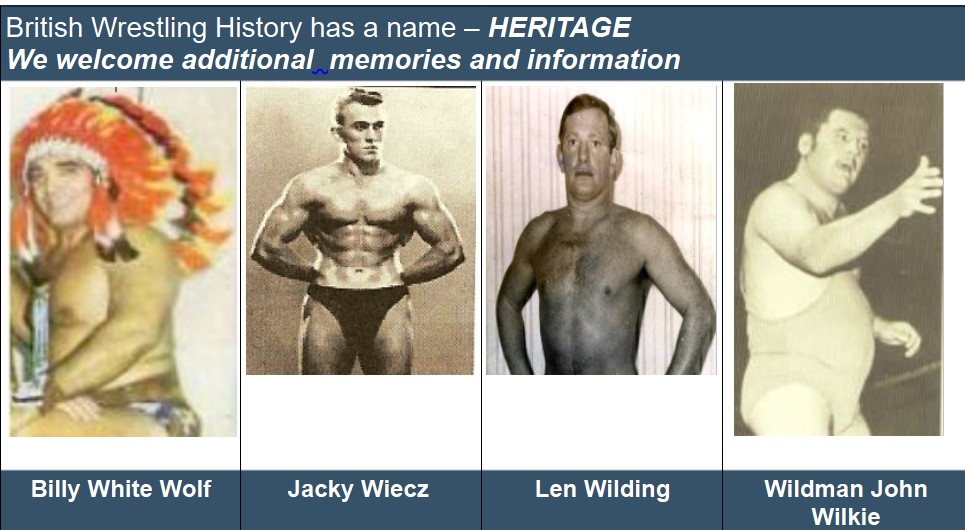
Billy White Wolf (Also known as Sheik Adnan Al-Kaissy, The Sheik)
The heroic native American looked every bit the part as he toured northern England and Scotland in the winter of 1969-70. Dressed in the usual attire he was certainly colourful but results were mixed against a set of opponents usually one notch down from the elite of the time – Hussey, Streiger and Pierlot being frequent foes. One of his rare ventures south saw him surprisingly rewarded with a Royal Albert Hall bout against Mike Marino, and more surprisingly rewarded with a drawn verdict. Graeme Cameron tells us that Billy White Wolf tagged with Mike Marino when both were in Japan during 1974. Look the part he might have done, but he was to return a few years later as the evil Sheik Adnan Al-Kaissy ! Said to be a school friend of Sadam Hussein, and influential in developing professional wrestling in Iran his colourful life story can be read in his autobiography, “The Sheik of Baghdad: Tales of Celebrity and Terror from Pro Wrestling’s General Adnan” To be fair to the wrestling promoters (we wouldn’t want to suggest they ever tried to hoodwink us poor fans), during White Wolf’s initial tour it was publicly stated that his father was Lebanese and he had learned to wrestle in the Lebanon. Much of what has been written elsewhere about Al-Kaissy we have been unable to confirm.
Maurice Whitfield
Maurice Whitfield is a mystery about whom we would like to know more. Curiosity was aroused by Heritage member Peter who had been told about this 1960s wrestler by a fan he met at Preston nearly sixty years later.
We found around a dozen matches for Maurice in 1960, against some good opponents that included
Ron Oakley, Cliff Beaumont, Harry Kendall and Ken Cadman.
So Maurice was clearly no fly-by-night and could hold his own with the best. Then in January, 1961 he appeared on television wrestling Jack Beaumont, one of the most skilled in the business. From 1962 onwards we found little activity, possibly because he went over to the independent promoters, where we did find him working for Don Robinson in 1962.
Ex wrestler Norman Curry came to our rescue. He remembered Maurice Whitfield, a middleweight from Sacriston, a village in County Durham,three miles north of the city of Durham. He believed he died about 1990. Bobby Robson also came from Sacriston. He is marginally more famous, but it’s good to give Maurice his place. Let us know if you can add anything.
Jacky Wiecz
The muscular sixteen stone French heavyweight made a short visit to southern England in March, 1972. The Frenchman had gained most of his experience in Canada, where he wrestled as Andre Carpentier. It was claimed that he was the nephew of former world champion Edouardo Carpentier, but there have also been suggestions they were father and son, and that they were not related at all. Take your choice. By the time he arrived in Britain he had returned to Europe and had set up home in France and wrestled in France, Spain and Germany.
Len Wilding
The popular Streatham welterweight was born in 1936 and turned professional wrestler in his early twenties following three years as an amateur at the John Rushkin Amateur Wrestling Club. As a schoolboy swimming was his first love and Len had earned his crust as a professional lifeguard before turning to the professional wrestling ring in 1958. For five years he was a regular feature on Dale Martin bils throughout Southern England. His career seemed to move up a notch in May, 1960, when he made his debut at the Royal Albert Hall, where he lost to Peter Szakacs. Fans were shocked when the young man that seemed destined for the top announced his retirement at the end of 1963. Fans had their chips when he went into the catering business
Henry Wilkie
We know little about Sunderland’s Henry Wilkie who newspapers declared a very skilled heavyweight. He appeared in the rings in 1934 when opponents like Jack Dale suggests he was a lighter man in those days. Post war he was advertised as a heavyweight and facing men like Robert McDonald, Francis Gregory and The Blue Mask, with whom he drew at the New St James Hall, Newcastle. In 1933 and 1934 we came across Wild Boar Wilkie, billed from Sunderland or Newcastle, but we don’t know if this was the same man.
Wildman John Wilkie
The hard man of the Potteries, from Stoke On Trent, erupted into our rings in the late 1970s. A rough, tough rule bender he was a television favourite in the 1980s making more than a dozen appearances. Remembered by many for his television contest with Fuji Yamada, and partnering Bulldog Brown and Sid Cooper against Big Daddy in ITV’s final wrestling show.
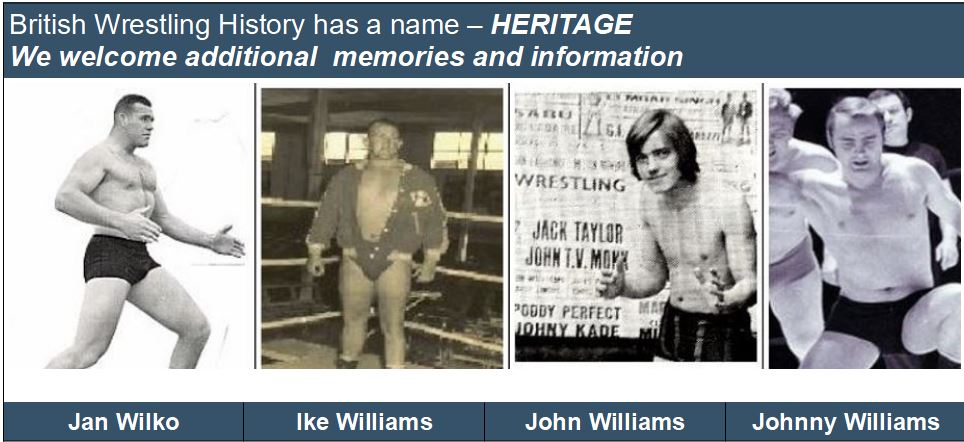
Jan Wilko (Also known as Jan Wilkens)
The Johnnesburg Giant was 22-year-old Jan Wilkens from South Africa who caused quite a stir when he arrived in Britain late in 1965. At 6’5″ and 20 stones, this ex-policeman demolished French Canadian giant Paul Vachon in 8 minutes on his Royal Albert Hall début. Charles Mascall, the doyen of British wrestling journalists wrote in The Wrestler:
“Jan Wilko, a handsome young Boer of 22 who is certainly one of the most perfectly proportioned mammoth men ever to take up the sport of wrestling. In about 4 minutes of the first round Wilko snatched a Boston crab hold and won the first submission. In the following round he smashed the giant French-Canadian to the mat with four successive pile-driving body slams. The bout was over in under eight minutes – one of the quickest contests on record at the Royal Albert Hall.”
Unusually invited back to the next bill, he was even quicker proving it had been no fluke, disposing of Big John Cox in just six minutes.
Back home in South Africa he welcomed and wrestled visiting British wrestlers down the years including Rocky Wall, Mal Kirk and, as late as 1981, Tiger Singh, in front of a national record crowd in excess of 20 thousand. We are told his final match was in Cape Town in 1987.
Definitely an international star we would have liked to have seen much more of.
Brett Williams
Bearded Yorkshireman Brett Williams worked for Cyril Knowles and Ace Promotions in the 1960s and 1970s. When not wrestling he could be found on his floating barge restaurant.
Ike Williams
Ike Williams was a rough, tough heavyweight on the independent circuit in the 1960s, and a regular worker for independent promoters such as Gordon Corbett, Lew Phillips and Jack Taylor around the country. A former RAF man Ike (or Trevor as he was in those days) was an amateur boxer, and one time sparring partner of Brian London, who became friends with Dwight J Ingleburgh when they were both working as security men at Butlins in the late 1950s.
Dwight encouraged Ike to give wrestling a try, and trained him for the professional ring. Trevor doubtless borrowed the name of Ike from his boxing hero, learned the trade and grew into the sport in more ways than one, tipping the scales around the 18 stones mark and standing just under six feet tall.
John Williams
Many young wrestlers have claimed to be the youngest in Britain (you can read about quite a few of them elsewhere in Wrestling Heritage) and when fifteen year old John Williams stepped through the ropes for the first time in 1971 he was said to be the youngest at that time. Quite possibly he was, but most definitely he looked the part, and fans at the cavernous Granby Hall, his local hall, and throughout the north and midlands took him to heart. His young appearance couldn’t disguise his wrestling skill, the result of many hours of knocking about with his famous father from an early age. That famous father was wrestler and promoter Jack Taylor. Jack had coached his son for many years before giving him his chance in the professional ring whilst still a schoolboy. Not that wrestling consumed all of the youngster’s energy because he was also a keen rugby player, swimmer and cyclist. John favoured training with weights which enabled him to progress swiftly through the weight divisions. John Williams died suddenly in 2009, aged just 53 years.
Johnny Williams (Birmingham)
Our records indicate a light to middleweight Johnny Williams active mainly between 1948 and 1955, for whom we have little information. He appears to have worked mainly in the south and was taken on by Joint Promotions following their formation in 1952.Opponents included Mick McManus, Bob Archer O’Brien, Vic Coleman, Eddie Capelli, Jack Dempsey and Jack Queseck. Our final record of activity is a tag match in Manchester in 1959, partnering Tiger Woods.
Johnny Williams (Cardiff)
Welsh lightweight Johnny Williams was a regular worker for Paul Lincoln Promotions in the early 1960s alongside other Lincoln proteges the Cortez brothers and Zoltan Boscik. With amateur experience from the United Amateur Wrestling Club in London he turned professional in 1961.
He was a fast, skilful wrestler, popular with the fans as he always stayed within the rules.
One time lightweight champion until he passed the belt on to Adrian Street.
Appeared in the 1962 recording of The Wrestling Game (recorded 6th October 1962) when he faced Jon Cortez.
As a full time Lincoln worker Johnny successfully made the transition to Joint Promotions in January 1966 where he became a popular figure in Dale Martin rings and nationwide through the exposure of television. He travelled extensively throughout Europe with visits to France, Spain, Belgium, Switzerland and even Libya.
Ken Williams
Brian Walker assumed the persona of Ken Williams in the northern rings of the late 1960s and 1970s. A fast and clever wrestler he often teamed with Colin Welford as one half of The Vulcans tag team. Trained by the great mid heavyweight champion Norman Walsh he did all sorts of things his mentor would never dream of. For instance Ken would run up the ropes and somersault backwards onto his opponent. His career, and life, was brought to an abrupt and tragic end from kidney failure, aged just 36.
Reg Williams
Here was a man with spirit, never one to shirk a good scrap. An often forgotten but worthy mid heavyweight of the sixties was Birmingham’s Reg Williams. Although usually associated with Birmingham Reg was based in Manchester for most of his wrestling career. A rough, tough grappler, it didn’t take a great deal for Reg to lose his temper. Made almost twenty television appearances in the first half of the 1960s, including unceremonious losses to both Rick Starr and Billy Two Rivers. Dave Sutherland told us that Reg Williams was “one of the most understated and underrated hard men of whom I never tired of watching.”
Fellow wrestler Eddie Rose remembered: ” I knew Reg well from long hours spent at the YMCA in Manchester. He was a wonderful ‘Fives’ player (its like squash but without the racquet). We usually had a cup of tea and a chat after training and he was a lovely, interesting but understated man and an excellent wrestler.”
Barry Willis
Barry Williamson shortened his surname to Willis, as had his dad, Johnny Willis. He was one of the youngest professionals at the time aged just sixteen after a championship winning schoolboy amateur career. Marty Jones was a contemporary. He had a baptism of fire when he was matched against Keith (Blood Boots) Martinelli. Barry survived and went on to a successful career with both Joint Promotions and on the Independents.
Barry had his own hairdressing business up the road from his dad’s pub which meant that wrestling bouts had to be fairly local because of the business.
He remembers bouts with Ian “Mad Dog” Wilson, Sugar Ray Francis, Pete Lindberg, Alec Burton and Eddie Rose. Barry still misses the wrestling life and wishes he could do it all over again (except the Martinelli bit)!
Johnny Willis
Johnny Willis: a popular middleweight of the 50s and 60s who was from Sale in Manchester. Johnny had bouts against the likes of Tommy Mann, Danny Flynn, Fred Woolley and Alf Cadman. In fact Alf broke Johnny’s leg in one hard fought bout. Johnny became a well-known referee on the Independent circuit in the later stages of his career as well as being landlord of the Charlestown pub just up the road from Booth Hall Children’s Hospital and Bogart Hole Clough in North Manchester. Johnny fathered another good wrestler, Barry Willis. The father and son teamed up as the Willis Boys for tag matches in the late 60s and early 80s and Johnny’s last bout was a tag with Barry versus Sugar Ray Francis and Johnny Jordan , a venue for which Barry still has the poster.
Dick Wills
Dick Wills had the reputation of being a very hard man, one of the very few who seemed to know no fear according to Athol Oakeley.
He was from Nothumberland but moved to south Lancashire to work as a coal miner. Consequently he was one of the hardest of the lighter wrestlers, but could also wrestle, and it was claimed by Oakeley that Dick was “the finest wrestler produced by England,” whose standing work was superior to that of his good friend and world champion, American Benny Sherman. Wrestling historian Charles Mascall was also an admirer, naming Dick Wills one of the world’s top middleweight wrestlers of all time. He rated Finland’s Waino Ketonen number 1, Billy Riley number 2, and Dick Wills number eight, just behind Jack Dale, “Not many wrestlers of any weight could have beaten Wills in his prime.”
Wills learnt to wrestle in the fields around his Lancashire pit, catch-as-catch-can style. Although often said to be amateur matches there was more organisation to Lancashire catch wrestling in the 1920s than is often given credit. Admittedly the majority of matches were in fields by working men having a pull around to earn a bit of extra money, but there were also scheduled matches with paying customers and the wrestlers receiving a percentage of the gate money. So, not amateur in the way most of us would understand.
In “Bue Blood on the Mat” Oakeley recounts the time that four gangsters entered the dressing room and threatened him. All other wrestlers apart from Dick Wills scarpered, but Wills physically stood between the men and Oakeley until they backed down and left the room. Not that he was brave, but he was a man who just didn’t have any sense of fear, according to Oakeley.
Although mostly associated with the pre-war all-in days Dick did continue wrestling for a couple of years following the outbreak of peace, He was British light heavyweight champion from 1932, possibly claiming the title during the unregulated years until as late as 1947, but titles are unclear and we cannot find any championship contest linking Wills to Bill McDonald who claimed the title in 1947.
Undoubtedly a hard and skilled wrestler who was British light heavyweight champion for a time, Dick Wills had neither the weight or charisma to rank alongside the famous names mostly remembered. Nonetheless, a great pioneer and top wrestler of the 1930s.
2245
 Wrestling Heritage