
These are our shorter Biographical portraits which we would like to extend if you can provide information or memories.
Bull Wilson
Bill (Bull) Wilson started wrestling seriously when in his mid twenties and was a heavyweight all his wrestling career. His love for good and wholesome food saw to that. He comes from the Govan area of Glasgow and his daytime employment was in the Hackney Cab Maintenance Industry. He ran a servicing and repair department in the city centre. Always a quiet family man he would bring the wife and kids down to the Sea Shore in Ayrshire, to enjoy the sun, if it shone that is, whilst he attended Sunday afternoon training sessions at Dale Storm’s Gym in the sleepy mining village of Mossblown, a stones throw for the town of Ayr. He was not the quickest around the ring but when he clasped on a hold, he was like a Rottweiler dog, and it was almost impossible to to break free when this very,very powerful individual had a hold of you. He was always great to be with and had a wonderful laugh and a friendly smile. He is well respected among the Scottish fraternity. Although his career, like other younger entrants, was cut short by the loss of ITV’S World of Sport and the subsequent demise of the long established halls, He had however, established himself, in a very short time as the man to beat, after Andy Robin in his weight division. His speciality was the Backbreaker, at which he was very successful. He was tough but never dirty! He worked almost entirely for the Independents and featured regularly for Spartan Promotions.
Eric “Tug” Wilson
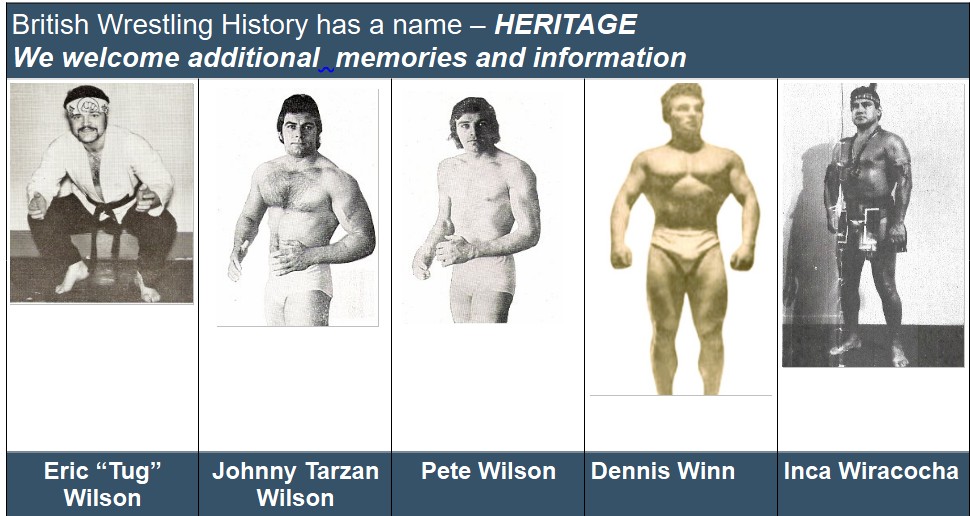
The name wasn’t original, there was a Tug Wilson wrestling in the 1930s and a bare knuckle heavyweight boxer of the same name in the 19th century. Nevertheless, Eric Tug Wilson was one of those that brought a breath of fresh air and reassurance to older fans at a time when the rings seemed dominated by oversized heavyweights of limited skill. Not that Tug was in any way dull; just look at the costume. Yet another of those judo black belts of which our rings seemed full, and dressed accordingly, Tug Wilson always provided value for money. He could wrestle, he could move, he could elicit sympathy and anger from the fans. Not just in singles matches, but in tag contests also he proved a fitting and worthwhile partner for Rollerball Mark Rocco. Tug was landlord of the Clarence Hotel on the Wilmslow Road, Manchester.
“Tarzan” Johnny Wilson
Footballer Johnny joined Dale Martins at the end of 1974. From the hunky-dory Portsmouth/Southsea/Fareham hub of south coast wrestling. He had a long and successful career, the highlight was, no surprises, a Royal Albert Hall defeat of his trainer, Big Bruno Elrington. Another memorable bout, at the same venue, was in September, 1977, when he partnered Roy St Clair against the Caribbean Sunshine Boys Johnny Kincaid and Soulman Dave Bond.
Why on earth the promoters didn’t bill him form the African jungle and have done with it we shall never know, it would have been far more interesting. A popular and skilled wrestler with fans throughout the south and further afield thanks to his television appearances.
Ken Wilson
By the mid 1930s Ken Wilson was wrestling around the rings of Britain, we have found him for the first time in 1935 against a young Vic Coleman. He was by all accounts, a classy middleweight with top class opponents that included Olympians Robert Cook and Norman Morrell in the 1930s and later Mick McManus, Bob Archer O’Brien, Jack Queseck and Eddie Capelli. Ken Wilson seems to disappear from our rings around 1952. He encouraged a good friend of his to have a go at wrestling. The friend? Mick McManus. The source of the story, Mick himself, in a 1962 interview in the Liverpool Echo.
Pete Wilson
After a couple of years with independent promoters, goalkeeper Peter joined his elder brother Johnny within the Joint Promotions network in 1975. They tagged successfully against heavyweight pairings and even against lighter weighted opposition such as McManus and Logan. Pete also had singles matches but never remained overshadowed by brother Johnny.
Dennis Winn
Dennis Winn was a very strong , muscular man who was a part time wrestler and part time tailor. Dwight J Ingleburgh told Wrestling Heritage, “He was a Leeds lad who worked mainly in the Yorkshire area, not travelling a lot because of his business. I worked with him on Cyril Knowles shows. If you upset him he could be a real handful.” Dennis’s physique gained him the nickname “The Perfect Man.” He was born in Leeds in 1931, As a physical culturist Dennis was a Mr Universe finalist in 1951, 1952 and 1953, highest ranking 2nd in 1952.His success in physical culture was followed by success as a wrestler when he turned professional in his early twenties.
Bernard Hughes told Heritage: “I saw Dennis Winn once at Newcastle. He was all right,had been taught some moves, but obviously a top bodybuilder. They always play on the posing. He asked me the way to Newcastle Central station, and as we walked he told me that he was going to America shortly after. What struck me most about him was that with his overcoat on, he looked as broad as he was tall.”
Inca Wiracocha
Inca Wiracocha was in Britain during the winter of 1963-4 billed from Peru, the sun god of the Incas. He wrestled big names like Gordon Nelson and Bill Joyce, but seemed to go down frequently, including losses against lesser lights of the time like Roy St Clair and Bob Sweeney. Big pay day seems to have been losing to Billy Howes at the Royal Alberts Hall on 29th April, 1964. TV listings against Billy Howes, Seamus Donlevy. The Sun God returned in November , 1970, when he partnered Gita Gonzales at the Royal Albert Hall to succumb to McManus and Logan.

Emile Wolfe
We saw Emile Wolfe a couple of times on independent shows around 1968 or 1969, a clean but unexciting middleweight if memory serves us correctly. That was our only experience of Emile and so we were more than a little surprised when he cropped up in The Who’s Who of Wrestling a year or two later. We have since learned that he did work for a short time for Joint Promotions and then vanished. We were told that Emile was Yugoslavian born but had learned to wrestle in Australia. Whether it’s true we don’t know but Wrestling Heritage members John and Margaret knew Emile and told us he met a nice girl from Widnes who he married.
Nonga Womba
Wrestling was never short of colourful characters with equally colourful names. Well Nonga Womba, “The Zulu Warrior” takes a bit of beating in that department. He visited Britain in February, 1954 and we have uncovered a handful of matches. Real life couldn’t quite match wrestling but Nonga Womba’s real name almost equalled his wrestling persona. Born in British Guyana his name was Henwood Adrian. His wrestling activities were merely a means to an end as Henwood was an artist, using wrestling to support his pursuit of art. He claimed to have encountered Norman Morrell by chance in Paris, resulting in Morrell inviting him to Britain where he lodged in Bradford. Opponents included Emile Poilve, Len Britton and Robert McDonald.
Alan Wood
Without question Alan Wood was one of the most under rated wrestlers of the Mountevans era. A product of the Riley gymnasium, and cousin of Snakepit torchbearer Roy Wood, here was one of the best welterweights of the 1960s. Brightly coloured wrestling trunks and a striped dressing gown were the closest the Coppull wrestler came to gimmickry. A professional debut on the Isle of Man against Dennis Rothwell led to a career in which he outwrestled the best and gained little of the credit. Either the politics of the professional wrestling business, or just a travesty of justice, saw him fail to win the British welterweight championship vacated by Jack Dempsey, or at any other time. Lack of recognition led to Alan leaving Joint Promotions and setting up his own promotional business (C&A) in the early 1970s, though he did return to Joint Promotins towards the end of his career.
Billy Wood
Lightweight silver medallist in the 1908 Olympic Games and amateur British middleweight champion in 1909. We have not established the link but he may have been the same Billy Wood who went on to the professional rings of 1930s, and wrote the foreword of “Wrestling: Catch-As-Catch-Can, Cumberland & Westmorland, & All-In Styles” in 1934. The book does cite Billy wrestling in Argentina in 1911 and France in 1913 Billy was certainly wrestling professionally as early as 1932, and was billed then as ex middleweight champion of the world. A man of some substance weighing just 13 ½ stones Billy took part in an elimination tournament for the British heavyweight championship, going out to Len Franklin in the semi final of the tournament (15 August 1932). In the 1950s when he must have been in his seventies, Billy was still involved in wrestling, running a fairground boxing and wresting booth.
Ken Wood
Stoke on Trent wrestler who trained at the gymnasium at the Black Boy Public House in Cobridge , Stoke on Trent, alongside Jim Mellor, Jack Santos and George Goldie.Made his professional debut against Goldie, at Hanley, on 18th September, 1939. A regular worker in the midlands during the war, we have no post war sightings.
Roy Wood
Wigan’s Roy Wood has a unique place in Britain’s wrestling heritage, as both one of the great shooters, a respected professional and one of the most influential of amateurs. As a teenager Roy started to learn the art of wrestling at Billy Riley’s gym, and learn he certainly did. It was 1961 when he entered Riley’s for the first time and began to learn alongside Billy Robinson, Billy Joyce, Jack Dempsey, Bob Sherry and Ernie Riley. Not much more than a year later Roy turned professional, and in the years that followed gained success both in solo matches and as partner to Johnny Eagles in The White Eagles tag team. Over the years Roy began taking more of a training role at Riley’s gym, with all of the seventies Riley based men benefiting from his knowledge. When the Riley gum in Whelley was beyond repair Roy and a friend, Tommy Heyes, literally re-built the place. In the 1980s they moved the gym to Aspull, where it is still based. Roy has devoted his time to passing on the Riley skills , and travels regularly to Japan teaching submission style wrestling to young Japanese professionals. Roy was Team Manager for the England Youth Wrestling Team that participated in the 2008 Commonwealth Youth Games in India.
Tiger Woods
Tiger (Freddie) Woods is one of those fondly remembered names of the post war years, though those with memories of this middleweight since the 1940s remember him only towards the end of his career, and in the 1960s as a referee in the Manchester clubs
Eddie Rose remembers the Manchester wrestler as “Chunky and bald and, outside the ring, wore a black leather trilby hat. What a source of jokes and stories, gags and memories he was. He kept the changing rooms in uproar in between bouts and it didn’t do to catch his mischievous eye in the ring becasuse he always sparked off at least a smile if not a fit of the giggles. Tiger’s “dizzy act” was a comedy classic on a par with Kellett or Critchley. He knew every little trick in the book and could milk a situation for a whole round if he felt like it. One of the best… ”
Wrestler Mark Hudson also recalled fond memories of the original Tiger Woods, ” I was wrestling at Manchester YMCA when ‘spotted’ by Arthur Wright of Wryton Promotions. This was early 1953. My trainer was Tiger Woods. We spent many hours together in and out of the ring. In fact my first bout was with him at the Tower, New Brighton. I was scared stiff but he saw me through and made me look good!”
Another ex wrestler, Al Tarzo, told us,“I only had the privilege of seeing Tiger work once when we were on the same bill at Atherstone. “What a showman. I have never seen a man that could get tangled in the ropes so easily and often. He had the crowd in hysterics. The ref was still trying to get him out of the rope when the bell for the next round sounded. Tiger Woods had the edge over Les Kellet in my book.”
Bill Workman
The east end of Londoner Bill Workman worked for London waterboard during the day and for the independent promoters in the 1960s, often for Jack Taylor’s International Promotions, but for many others also, including Paul Lincoln. Mick Collins told us, “I remember Bill very well and had the pleasure of working with him when I was very young and just started in the business. I Seem to remember he gave me some tuition in the ring that night (only me and him knew) which I never forgot.”
Bernie Wright (Also known as Bearcat Wight)
Bernie Wright was the brother of Wonderboy Steve Wright. With a few years experience under his belt he crossed the Atlantic to Canada in 1983 as Bernie Wright, developed a more rugged style from Britain’s John Foley who was living there and returned unrecogniseable as Bearcat Wright. Heritage member Mad Mac remembered: “Bernie returned from Calgary as Bearcat Wright with a rather bizarre “reverse Mr. T” hairstyle. Also rather bizarrely, ‘Bearcat Wright’ was a well-known US wrestler who died prior to Bernie adopting the name. The original Bearcat also happened to be a gentleman of colour!”
Reuben Wright
A big man weighing 19 stone and over six feet tall Texan Reuben Wright was brought to Britain in 1938 to wrestle Canadian Earl McCready at the Royal Albert Hall in London.The contest promised to be another revival of scientific Catch-as-Catch-Can style, but the bout failed to capture the public’s imagination despite coverage in the national press. Daily Express reporter, John McAdam, said the wrestling was so good it had converted him to the wrestling business. Three thousand fans turned up to witness McCready win by one fall to nil in the sixth round, but that wasn’t enough to prevent the promoters making a loss. Wright wrestled around the world, finally retiring from the sport in 1965.
Reuben Wright died on 9th November, 1983
Wonderboy Steve Wright (Also known as Bull Blitzer)
The sixteen year old really did seem a “Wonderboy Wright,” as he was billed, when he hit the Northern wrestling circuit aged just sixteen years old. He whizzed around the ring like no other and can justly be considered the start of the 1970s speed revolution.
His first professional bout, a sensational win over veteran Romeo Joe Critchley, was a clear sign that here was a youngster with huge potentia.l He was the forerunner of a contingency that included the likes of Dynamite Kid and Davey Boy Smith and took wrestling to new levels of agility, athleticism and speed.
Wright was trained by Ted Betley, the man who was to later bring aforementioned Kid, Smith and Marty Jones into the professional wrestling business.
Later in his career Wright adopted the persona of Bull Blitzer, an alleged German villain, who defeated Marty Jones for the World Mid heavyweight title in December, 1984. It seemed ridiculous to us then and equally so now. Steve travelled to Japan, where his agility was valued, finally settling in Germany.
His son, Alex Wright, went on to also become a successful wrestler.
Harold Wrigley
Harold Wrigley was one of the old timers from Manchester, known for his body building skills and renowned as a very strong Manchester heavyweight. He had a gymnasium in Failsworth, Manchester, where many wrestlers learned the trade in the 1950s and 1960s. Harold wrote the foreword for Pete Lindop’s book, “6ins Nail & Iron Bar Breaking made easy.” He also had a business sideline of selling health products, packed by his wife we believe. Harold also wrestled as the Rasputin in the 1960s.
2249
 Wrestling Heritage