
Wrestling Heritage welcomes memories, further information and corrections.
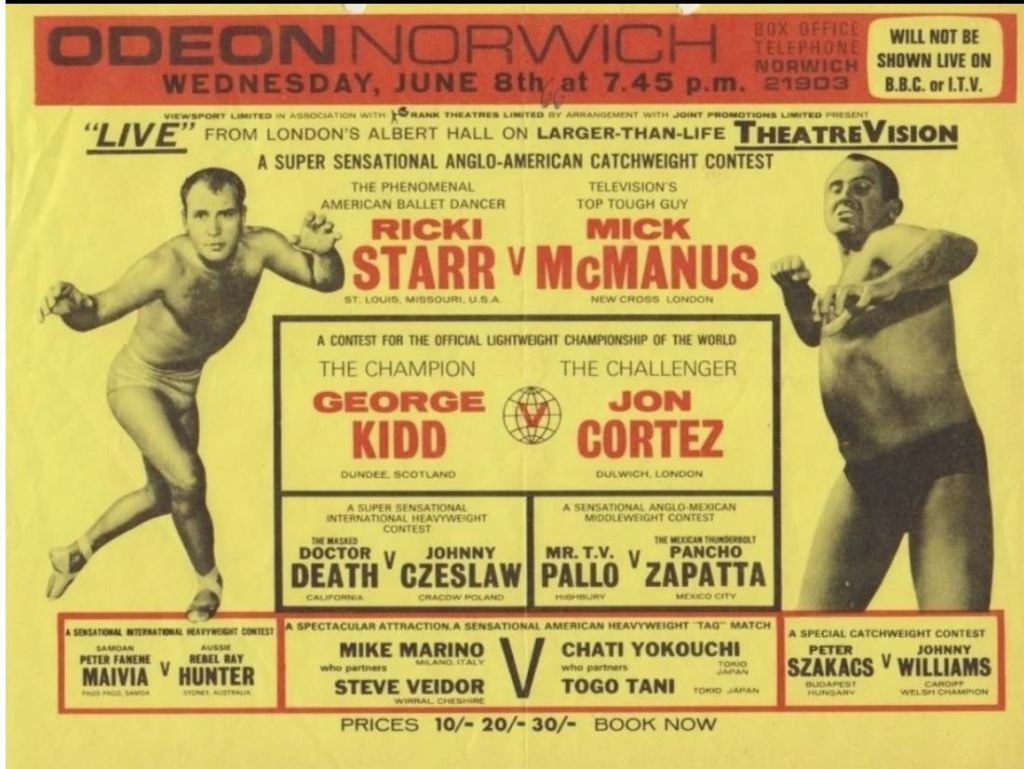
Wednesday June 8th, 1966, was another of those landmark days in Britain’s wrestling history. It’s hard to believe with 5,000 fans inside the hall, and thousands more viewing live on cinema screens around the country, there were still an estimated 3,000 disappointed ticketless fans left standing outside the Kensington arena with nothing to do but buy a bag of chips as they shuffled their way home. Professional wrestling in 1966 was big business, and this was wrestling at it’s peak of popularity.
A top of the bill match between Ricky Starr and Mick McManus would have been enough to fill the hall, but the occasion was about much more than one match.
In October, 1962, the last race meeting was held at the Hurst Park Racecourse in Surrey. Shortly afterwards the racecourse was sold. Following the sale the Hurst Park Syndicate moved into promoting, bookmaking, pay tv, closed circuit television and property.
In April, 1964, the Hurst Park syndicate bought Dale Martin Promotions, the biggest wrestling promotion company in the country. Shortly afterwards they formed Viewsport. Viewsport had an agreement to provide programming to Pay-TV, a company that in January, 1966, was granted a licence to provide an experimental pay tv service to parts of Sheffield and London. Viewsport also won a contract to relay live sporting events to cinemas around the country. In May, 1966, Viewsport won the live rights to screen the World Heavyweight Boxing Championship between Henry Cooper and Muhammad Ali at cinemas around Britain. Ten days later the Indianapolis 500 motor race was broadcast live from the United States.
A week later, on 8th June, it was the turn of professional wrestling. Five thousand ringside fans and an estimated 12,000 more watched the Dale Martin tournament live in cinemas in Bournemouth, Bristol, Cardiff, Coventry, Derby, Glasgow, Leeds, Leicester, Norwich, Nottingham, and Sheffield. In these days of paying large sums of money to watch sporting events live on satellite television from your own armchair it’s easy to underestimate just the significance of this event.
It was an occasion that demanded something special, and Dale Martin Promotions certainly did not disappoint.
Top of the Bill was an encounter between Mick McManus and Ricky Starr. We’ve often been critical of catchweight contests but the thought of the seemingly invincible McManus encountering the unconventional and unvanquishable Starr was enough to whet any wrestling fans appetite. A comprehensive win by either man was unthinkable even in 1966, and Starr ended an unsatisfactory victor when McManus was disqualified in the sixth round.
Equally memorable, even to those who weren’t actually there (thanks to the photos of a blood spattered Mike Marino in The Wrestler) was the tag match in which Marino and Steve Viedor overcame the sinister Japanese team of Togo Tani and Chati Yokouchi.
Masked Man Doctor Death, (who in his other guise had sold out his wrestling business to Dale Martin Promotions six months earlier) made his Royal Albert Hall debut and predictably overcame Johnny Czeslaw.
World lightweight champion George Kidd made a rare return to London to defend his World lightweight title. Jon Cortez put up a brave fight, but bravery was not enough, and Kidd kept hold of his belt. Of course.
Jackie Pallo was the good guy for once as he overcame Mexican villain Pancho Zapatta.
John Lees was a fortunate substitute for Rebel Ray Hunter. Fortunate to appear on such a prominent stage; less fortunate in the outcome as he lost to Peter Maivia.
Finally spare a thought for Peter Szakacs and Johnny Williams. They had the unenviable task of opening the tournament. An important role to warm up the audience but not to create too much excitement to upstage those who were to appear later. Hungarian Szakacs came out the winner.
5217
 Wrestling Heritage