

Any mention of wrestling in Blackpool and the name of Jack Pye will crop up almost immediately. Yet professional wrestling in Blackpool extends back many decades earlier than King of the Ring Jack. In the early years of the twentieth century, European champion Tom Canon defeated American Jack Carkeek, and in October 1902 the legendary Russian Lion George Hackenschmidt and a troupe of wrestlers rolled up in town to appear nightly for one week at the 3,000 seater Alhambra Theatre.
We have to wait another thirty years for wrestling to return to Blackpool, but this time it was here to stay. These were the early days of All-In, a new style of wrestling that had already gained a foothold in the United States and South Africa. Professional wrestling came to the Blackpool Stadium in the summer of 1932. Newspapers reported the Black Tiger repeatedly banging the head of British champion Atholl Oakeley on the canvas until restrained by the MC, referee and two seconds.
Amongst the wrestlers appearing in the 1930s were the ferocious sounding Norman the Butcher, resplendent with trademark yellow trunks, and a yellow dressing gown adorned with a skull and cross bones on the back; the audacious Karl Reginsky who as Hitler tightened his grip on power goose-stepped around the ring giving the nazi salute, rugby player and champion wrestler Douglas Clark, and, of course Jack Pye.
Precisely when wrestling moved to The Tower we cannot determine, but regular shows were certainly taking place by January 1937. William Bankier, otherwise known as “Apollo the Scottish Hercules” was brought in as promoter of the tournaments. In February 1939 newspapers reported that a masked wrestler, Mephisto, annoyed the fans sufficiently enough for them to pelt him with hot potatoes, sweets and oranges.
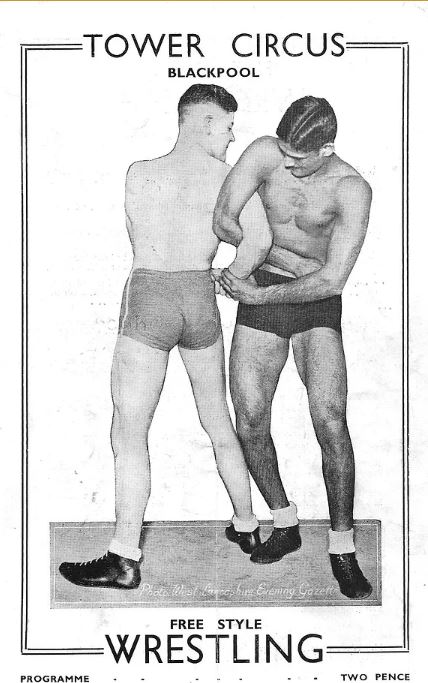
With the outbreak of war in September, 1939, wrestlers were called up; the country had other things on it’s mind and many towns cut back on wrestling tournaments. Not Blackpool. William Bankier continued to put on shows at the Tower, with members of H.M. Forces admitted at half price. In a nation at war the Government were keen to create a sense of normality amongst the population. Normality included going to the cinema, the dance halls, variety theatres and, of course, the wrestling! Blackouts were in place, ration books at the ready bananas were in short supply, Britons were digging for victory, and wrestling fans were reminded to bring their gas masks!.
Three shillings and sixpence (17 ½ pence) bought a ringside seat at the Tower during the war years. Wrestlers appeared on the shows as their wartime commitments permitted.
The wrestling stars of Blackpool were as colourful and as great as anywhere else. Doulas the Turk would carry out his prayer ritual before every match. It rarely worked. Black Butcher Johnson, said to be the Wild Man of Borneo was in reality Athur Howe the son of a circus strong woman, the Islington Hercules Bert Assirati and the Swedish scissors king Anaconda, otherwise known as Harry Purvis.
Following the war greater discipline was introduced to professional wrestling, making it a more suitable entertainment for families. A new promoter, Billy Best, from the Liverpool boxing family took over. Post war crowds flocked to see the shows featuring the new masked sensation Count Bartelli, the bearded Man Mountain Bill Benny, the fearsome Ghoul, and the Uncrowned King of the Mat, Jack Pye.
Jack Pye was a blueprint for professional wrestling villains for the following half century, one of that small and exclusive group that can be said to have changed the face of their chosen profession. When it came to charisma he had it in bucket loads; his arrogance and tactics made Jack the man that fans loved to hate. By the mid 1950s Jack and the Pye family had moved to Blackpool and the became a near permanent fixture on the weekly shows.
All seemed to be going well with holidaymakers filling the tower during the summer and locals keeping the winter shows going during the winter. All well until the shock announcement in July 1953 that there was to be no more wrestling or boxing at the Tower. Fortunately common sense prevailed and by October the weekly shows were restored.
There was drama outside the ring on February 16th, 1954. 3,000 fans watched the action in the ring not knowing that two hundred feet above them firemen were fighting a fire that broke out on wooden scaffolding used for maintenance of the Tower.
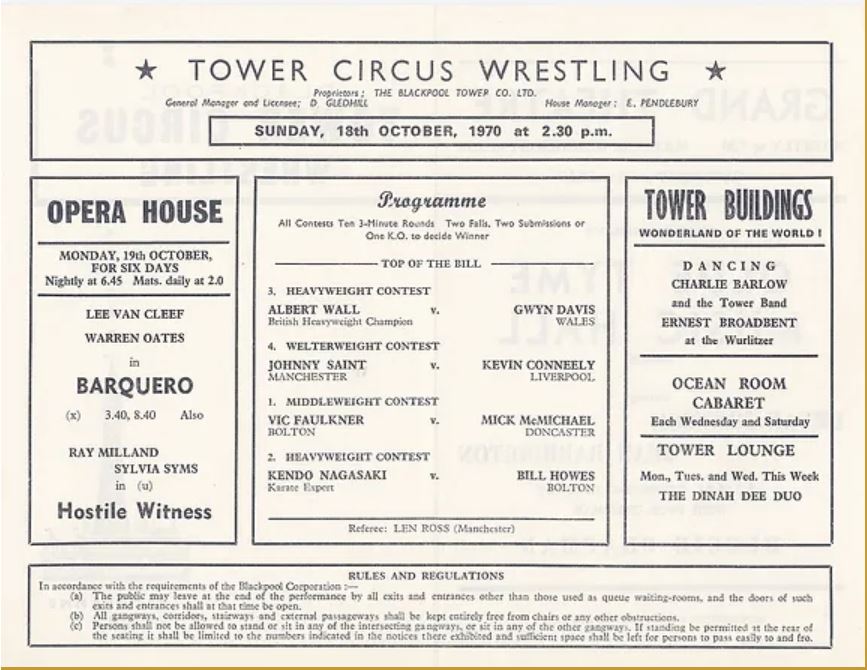
For thirty more years the Tower remained a mecca for wrestling with all the television stars of wrestling appearing in the weekly shows. Big Daddy, Les Kellett, Jackie Pallo, Zebra Kid and Kendo Nagasaki were amongst the big names that entertained thousands of fans until wrestling left the Tower in the 1980s after fifty glorious years.
 Wrestling Heritage