
For Ray Noble Belle Vue was a place of Blood, Sweat and Speedway.
Ray Noble was fifteen years old when he first went with friends to the wrestling at Belle Vue. It was the start of a love affair with the sport that was to last for many years and holds fond memories until this day.
“It was the best two hours entertainment in Manchester,” Ray told Wrestling Heritage, and went on to recall vividly the magic of Belle Vue. The fun fair, the zoo and the speedway which covered spectators in red dust rising from the track.
For Ray, though, the memories are of the wrestling. Three shows a week at its peak, with just about every big name in the business appearing at the huge Kings Hall venue. The anticipation when the bright ring light was switched on, the house lights dimmed and calls from the fans to “Wheel ‘em in.” Over 5,000 enthusiasts cheered their favourites and vociferously reassured the villains that they were doing their job well.
When Ray went through the doors for that first show the venue already had the longest tradition of professional wrestling in Britain. Over twenty years earlier, on 15th December, 1930, Belle Vue had hosted its first All-In wrestling tournament, the new style of wrestling introduced to Britain by Henri Irslinger. On that cold December evening fans had passed through the gates of Belle Vue to see Athol Oakeley beat Bert Assirati.
It was the start of five decades of wrestling at Belle Vue. In fact the Belle Vue wrestling tradition extended even further into history. Although the Kings Hall venue that is still remembered was first used for wrestling in 1921, the sport had been introduced to Belle Vue in 1910.
If one wrestler is associated with wrestling at Belle Vue that man was Dirty Jack Pye.There was a saying that put Jack Pye on with one of the Belle Vue Zoo’s monkeys and he would still fill the stadium. Ray was a huge admirer of Pye, who engaged in some of the roughest and bloodiest bouts at the venue. Ray is firmly of the belief that Pye’s contribution to wrestling history was good enough to have justified him a place in our Wrestling’s Most Influential list. Not just a place, but the number one position. “There was no one else like him,” Ray told us, “He filled stadiums for years wherever he appeared.”
Throughout the 1930s, as the new style of wrestling gained huge popularity the biggest names in wrestling appeared at Belle Vue. Bert Assirati was a regular visitor. He returned to Belle Vue just two weeks after that first show, beating Henri Irslinger and demonstrating to fans that although a young man he was a wrestler to be reckoned with. A further indication of his potential greatness came in March, 1931 when Belle Vue fans saw Assirati defeat George Boganski by straight falls. Within the decade Boganski would be claiming the World Heavyweight title.
Jack Pye’s biggest opponent at Belle Vue during the 1930s came on 7th November, 1931. Allegedly standing seven feet tall and weighing over 26 stones Carver Doone was undoubtedly a big lad. Pye beat him by two falls to one. Another powerful contestant, possibly the most powerful of them all, was Karloff Manoogian, a fearsome Armennian with facial scars reputedly caused by a sabre whilst he was serving in the Russian army.
Douglas Clark and Bulldog Bill Garnon were two more wrestling greats to appear at Belle Vue in those pre war days. Both claimed the British heavyweight title in the early 1930s but on the 2nd November, 1934, Clark beat Garnon to settle the matter
The great Jack Sherry overcame the powerful Douglas Clark on 11th November, 1938, when the British wrestler retired injured. In his book “Blue Blood on the Mat” Athol Oakeley wrote: “Although Jack’s appearances at Belle Vue always attracted a capacity house it was some time before the knowledgeable wrestling audiences of the North realized that here was the master matman. Then Sherry beat the world heavyweight champion (Cumberland and Westmorland style) without apparent effort. The ease with which Jack had handled this man, eighteen stone Douglas Clark, exemplified his terrific strength.”
Other famous names that appeared at Belle Vue in the 1930s included Half-Nelson Keyes, Harry Brooks, Billy Riley, Francis St Clair Gregory, Whipper Watson, Harold Angus, Izzy van Dutz, Ray St Bernard, Vic Hessle, and Karl Pojello. “Hard boiled” Herbie Rosenburg was hugely popular with his clowning antics entertaining the fans. At the other end of the popularity spectrum Carl Reginsky would enrage fans by goose-stepping around the ring and giving the Nazi salute.
The outbreak of war curtailed wrestling in all but the biggest venues. Belle Vue was one of those few places that remained open for the wrestling business. There were two shows a week on Saturday, an afternoon and evening show. Wartime bills consisted of those wrestlers who were available either because they were on leave, in local barracks, or who had not been called up. Regulars included Jack Atherton, John Hall, George Gregory, Dave Armstrong, Billy Riley, Val Cerino, Bill Garnon, Bill Ogden, alongside newcomers Jeff Conda, Jim Hussey and Billy Joyce. The British heavyweight championship was disputed throughout the war years. George Gregory had claimed the title by default when Douglas Clark had failed to turn up to make a planned defence against Gregory in 1938. The Islington Hercules, Assirati, also began to lay claim to the title.
The Bellle Vue promoters recognized the claim of Gregory, but brought the two men together in January 1945 in an attempt to settle the issue. George Gregory, from nearby Bolton, was billed as defending champion, but the partisan Lancashire crowd was not enough to prevent him from losing the title to Assirati. These two were to become frequent foes during the 1940s.
The end of the war was celebrated in the usual style at Belle Vue with Bert Assirati and Bulldog Bill Garnon knocking each other about and ending in a “No contest” when they wrestled in the first main event of peacetime. Assirati was to suffer one of his rare defeats in the following year, on 17th July, when he was disqualified against Alf Rawlings.
Assirati granted Gregory a return contest, and held on to the title, on 31st August 1946. Also on the bill was the popular Irishman, Danno Davey. Davey was an almost permanent feature on Belle Vue bills during the post war years tackling opponents that included Tony Baer, Rex Gable, Iron Duke, Alf Rawlings, Vic Hessle, Tony Mancelli and Billy Joyce.
The end of the war meant that wrestling returned to many other venues around the country. Servicemen began to trickle home and a group of established promoters began to build the foundations of the post war revival. Twice weekly shows continued at Belle Vue with heavyweights Assirati, Pye, Baldwin, Garnon and Ray St Bernard topping the bills. Amongst the lighter wrestlers were Danny Flynn,Jim Mellor, Jack Dempsey, Danno Davey and Jack Dale. Domestic favourites were boosted by overseas visitors Felix Miquet, Pat Curry, Kiwi Kingston, Bert Van Der Auwera, and Legs Langevin.
In the early 1950s teenager Ray Noble listened eagerly to friends and family as they discussed the famous wrestlers who appeared at Belle Vue week in and week out. Without the aid of television he could only imagine the goings on inside the grounds of Kings Hall, Belle Vue.
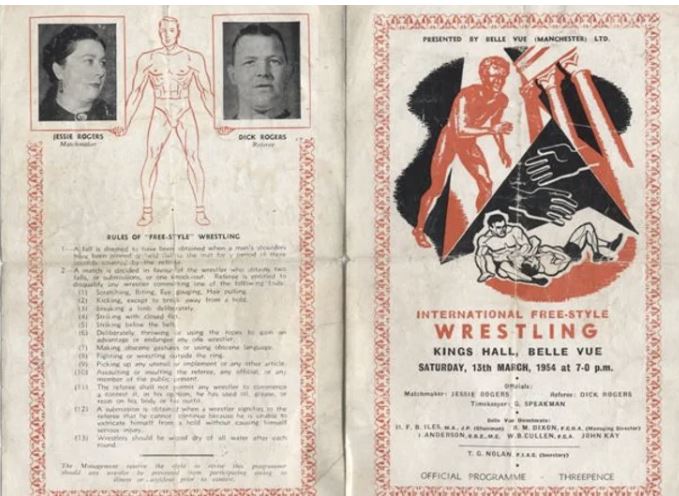
Ray had been taken to Belle Vue as a child, visiting the fun fair, the zoo, the lake and gardens. One evening in 1954 the walk through the gates was particularly exciting, because for the first time Ray walked past the lake and the fairground, heard the sound of the speedway track in the distance and headed into the vast Kings Hall arena for his first wrestling show. The noises, the smell of cigarette smoke, the bright light shining onto the centre of the ring attacked his senses and Ray was hooked.
Top of the bill pitted two villains, Bill Benny against the young son of the Doncaster Panther, Dominic Pye. Also on the bill were Lancashire favourites Billy Joyce, Tommy Mann and Fred Woolley. Ray was enthralled and in the years to come he became a regular and watched the biggest names in the business.
His memories are vivid. Dick Rogers was referee in those early shows, and a few months later Ray was surprised to see Rogers actually wrestling. This time he was billed as Dick the Dormouse and faced a formidable heavyweight who was one of the Belle Vue regulars over the years, Man Mountain Bill Benny. Benny was almost a weekly feature during the 1950s, with his best win being victory over Ernie Baldwin on 10th February, 1951. The following month a heated clash between Benny and Jack Pye ended in the disqualification of Pye. Benny was no blue-eye, though, and when the two met again both wrestlers were disqualified.
Another regular at Belle Vue in the early fifties was the Belgian heavyweight, Karl Istasz, a frequent visitor who came to Lancashire to learn catch style. Istasz, who was to later gain international success under the name of Karl Gotch, made extensive visits to Wigan, learning to wrestle at Riley’s gym and lodging with Billy Joyce and his wife, Edna. He appeared almost weekly during the early 1950s, gaining experience by wrestling the top heavyweights. Dave Armstrong, Emile Poilve, Alf Robinson, Hassan Ali Bey, and Jim Foy, The Mighty Elmo, were other popular regulars. Belgian Baptiste Benoy visited Belle Vue in 1953 but failed to take the European Light heavyweight title from Vic Hessle.
One visiting continental heavyweight who made an impression during that first season was the Parisian, Giles Wacklis. Wacklis debuted against Vic Hessle on 31st March, losing in the third round. In subsequent weeks he was back at Belle Vue to tackle Joe Cornelius, Sonny Wallis, Johnny Sereni, Norman Carter and Ted Beckley.
Possibly the greatest moment for Ray came on 2nd October, 1954. That was the night that he met wrestler turned boxer turned wrestler Primo Carnera, who knocked out the Swede, Anaconda. Ray was walking through the gardens at Belle Vue when he saw the former World Heavyweight Champion strolling through the grounds to drum up interest by stopping to talk to fans.
As befitted the Ambling Alp he was standing beside a massive imitation rock, introduced for the recent filming of “A Kid for Two Farthings.” Carnera was laughing and talking about the very rude antics of a group of monkeys playing on the rock.
Ray remembersed the excitement of going over and chatting with the big Italian who towered above him. Shortly afterwards Carnera was towering over Anaconda, winner by a knock out.
In December a young Joe Cornelius made his Belle Vue debut, losing by straight falls to Istasz. The huge Frenchman Felix Miquet was another of numerous overseas visitors. He stepped into the Belle Vue arena in July, 1955 to tackle one of the Manchester regulars, the bearded goliath, Bill Benny.
Over the following thirty years wrestling at Belle Vue was a microcosm of wrestling in Britain. Just about every wrestler appeared before the Kings Hall crowds, every championship belt was contested, careers were made, and careers ended.
A young Pole by the name Eugene Stezycki had arrived in Britain in 1954, debuted at Belle Vue the following year, and in 1956 gave British heavyweight champion Assirati the fight of his life. It was a return contest from a similarly fierce tussle in Brighton a few weeks earlier. The Belle Vue fans cheered the young Pole and knew they were seeing a star in the ascendancy. From that time on Stezycki’s place in wrestling was established, and that place was often in the opposite corner of Assirati, who he wrestled almost fifty times over the following three years.
At the end of the 1950s the Belle Vue fans had a new star to cheer, and he was one of their own. Manchester’s Billy Robinson moved effortlessly from amateur wrestling at a world level to success in the professional arena. A number of clashes with his mentor and rival, Billy Joyce, are remembered by Ray and other fans until this day. Masked men Count Bartelli and the Mask were regulars in the 1950s, to be joined in later years by The Zebra Kid, The Monster, The Outlaw and Kendo Nagasaki.
As television made the most successful wrestlers household names they were all attracted to the vast Belle Vue arena. The Pye family, the Faulkners, the Belshaws, Jackie Pallo, Mick McManus, Les Kellett. Billy Joyce, Eric Taylor, Tommy Mann, Jack Dempsey and everyone who was anyone climbed into the Belle Vue ring during the sixties. Add to the domestic names the best of the overseas visitors, George Gordienko, Gerry de Jager, Ray Napolitano, Ricky Starr, Sheik Wadi Yousseff, Paul Vachone, Tim Geoghegan Texas Buddy Cody, and the most colourful of them all, Billy Two Rivers.
Wrestling in the 1970s continued every Saturday night at the Kings Hall. The big names were still appearing, and outwardly little had changed. The established stars such as Les Kelllett, Jackie Pallo, and Rocky Wall were now joined by the new breed of faster, more athletic wrestlers, Wonderboy Wright, Dynamite Kid, Tony St Clair, Wayne Bridges, Mark Rocco and Dave Finlay.
Something was amiss, however. As was happening throughout the land the fans were beginning to stay away. They had tired of seeing many of the same old names on the bills and attendances throughout the country began to fall in the late 1970s. The big bills still attracted full houses, but it was clear that the fortunes of wrestling, and indeed Belle Vue itself, were in decline.
Fans queuing to enter the Kings Hall on a Saturday evening would mutter to one another that things were not what they used to be. They knew the decline could not last much longer.
Professional wrestling at Belle Vue had witnessed not one, but two golden eras, The Kings Hall had been filled to capacity to watch the pioneers of the modern day sport in the 1930s, and the fans had returned once again for the post war revival. Only London’s Royal Albert Hall could match the place of the Kings Hall in wrestling’s rich heritage. Everything has it’s day, and professional wrestling at Belle Vue was nearing the end.
There was an inevitability of the announcement that fans dreaded would be made sooner or later. The whole of the Belle Vue complex was by now a shadow of its former self, and the pleasure arena of the north was now no more than prey for the property developers of the region.
The tragedy of the decline must have been felt as much by the wrestlers as the fans themselves. The memories and the significance of Belle Vue must have been just as strong for the likes of Jim Hussey, Billy Joyce, the Gregory family, the Faulkners, the Pyes, as they were for fans like Ray Noble.
In November, 1981, regular fans were well prepared for the announcement that seventy years after wrestling had been introduced to Belle Vue the final show would take place on Saturday 5th December. The day and time were the same would be the same as they had been in living memory, but everyone knew there would never be another day and time quite like this one. This was to be the end of an era that would affect the lives of thousands of wrestling fans.
The occasion was celebrated by the promoters of the day in a half hearted way that was symptomatic of much that was wrong with the wrestling business. Incredulously the programme for the evening failed to acknowledge the significance of the occasion, and even invited fans to book for the next tournament!
Inevitably the evening of 5th December, 1981, was an emotional occasion. Many of those involved in Belle Vue’s wrestling history were present
Amongst the great and the good of the wrestling world was Ray Noble, a fan of almost thirty years. For him part of his life’s history was coming to an end, and for that reason he was accompanied to that final show by his wife and six children. It was one last chance to get them to understand.
Four supporting bouts were fitting for the occasion. Marty Jones, Johnny Saint, Mark Rocco, Dynamite Kid and Alan Dennison were the sort of wrestlers in whom wrestlings future could be trusted, if only it were that simple. The main event, a tag contest, serves as a reminder to all why Mountevans era wrestling was entering its final decade. The events of the evening proceeded as they had done on countless occasions over the previous five decades. For the last time fans cheered the heroes and booed the villains, and goodness prevailed as Big Daddy and Alan Kilby overcame their villainous opponents. As the bell rang for the end of the final contest there was growing expectation amongst all those present.
The event was to be marked by a parade of past stars, each being called to the ring to make their entrance for one last time.
The twentieth of them was the man who more than any other is probably associated with Belle Vue wrestling. Seventy-seven year old Jack Pye was wheeled into the arena, struggled out of his chair and climbed the steps for the very last time.
The crowd rose to their feet, and cheered the Doncaster Panther as enthusiastically and as loudly as on any occasion in the forty years previous. For the very last time Jack sent the fans home happy.
 Wrestling Heritage