
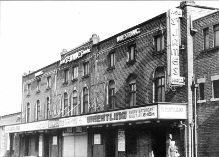
One of the most iconic wrestling venues of the twentieth century has a wrestling heritage that extends back to the beginning of 1931. Henri Irslinger, if Atholl Oakeley is right, was both promoter and main event attraction.
The first All-In wrestling matches were held at the hall on 24th February, 1931*. Four matches took place, two of them in the familiar Catch-as-Catch Can style and two All-In. The first All-In match was between Joe Robinson Sr (father of Tiger Joe Robinson) and Bill Garnon. Robinson won by two falls to one in a contest reported to be fairly tame and not dissimilar to Catch style. The match between Atholl Oakeley and Henry Irslinger was a much more violent encounter with eye gouging, strangling and fighting outside the ring. The match ended in the fifth of the ten minute rounds with Irslinger pinning Oakeley. In the two Catch matches Richard Wills defeated Walter Tolley and Billy Carr defeated Billy Windy.
Wrestling returned to the fall the following week. There must have been great confidence in the venue as most All-In shows (including those inaugural ones in London and Manchester just six weeks earlier, had been a couple of wrestling matches tagged on to the end of a boxing show. The second show, in which Henry Irslinger beat Bert Assirati in the main event, attracted a larger audience than the first.
The hall had been open for less than a year, ostensibly as a boxing venue. In the decades that followed there was far more wrestling than boxing at the hall, with wrestling shows becoming weekly affairs from 1936 until the closure of the hall in 1968.
The New St James Hall was a replacement venue for the original St James Hall, with an entrance on St Andrew’s Street. The original hall, designed by Percy Browne, had opened in 1909 with a capacity of 3,000 people. The new hall, The New St James Hall, with an entrance on Strawberry Place, was even bigger. Designed by architects Cowe and Lawson, it could seat around 4,000 people.
It’s a place with fond memories for many Heritage members. Six year old Powerlock first went along to the hall with his dad and granddad in 1963. Bernard Hughes has thrilled us with his memories from the 1950s and David Sutherland with stories of his ice cream sales. Ian is another long term fan at the hall and has researched the archives at his local library to discover the big names who have wrestled there.
Henry Irslinger, George Boganski, Norman the Butcher, King Curtis, Jack Pye were all regulars at the New St James Hall in the early 1930s. Women wrestling, advertised as Catch as Catch Can style, was staged at the hall on 27th March, 1933. The “Imperial Troupe of Lady Wrestlers” were applauded when entering the ring in their woollen bathing costumes.
As the sport became increasingly popular wrestling became a weekly Saturday night event at the hall in 1936. Ron Historyo has again been rummaging through the archives. In the 1930s the wrestling shows began at 7.30pm, as they did in most towns. Take note of the promoter’s instruction that patrons should not all turn up at 7.30!
At the outbreak of war, in September 1939, the start time was brought forward to 7.00pm. Even Hitler could not stop the wrestling at the New St James Hall. Weekly shows continued throughout the war years. An exception to the wrestling in 1940 saw one show on a Wednesday, Christmas Day! By 1943 the start time of the wrestling had been brought forward to 6.45pm, and was to remain at that time until the closure of the hall in 1968.
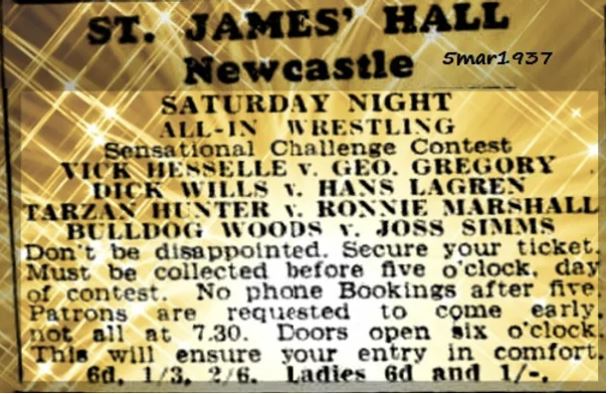
Promoters capitalised on the fans flocking to the Newcastle United games at the adjacent St James Park, imploring them to “Make a day of it.” Powerlock recalls that starting the wrestling at 6.45 pm just allowed football supporters time to nip into one of Newcastle’s oldest pubs, The Strawberry, before joining the queue for the wrestling about 6pm.
Just about every big name in British wrestling appeared at the New St James Hall down the years. Bernard Hughes remembers Les Kellett as the resident referee before he became a wrestling star, whilst his most vivid memories are of The Ghoul, “In the late 1940’s early 1950’s, the most popular wrestlers at Newcastle were local boys Norman Walsh from Middlesbrough and Alf Rawlings from Stockton on Tees . However promoter Norman Morrell’s top drawing card was undoubtedly The Ghoul.”
Bernard recalled one match of The Ghoul against Hassan Ali Bey, said to be the world’s strongest man. “Hassan came into the ring in his red fez and black boots. He got a submission fall in about round 4. In round 6 The Ghoul’s right hand went up to chop and the crowd shouted. Hassan just stood there. Chop! Down came the hand and Hassan smiled. He indicated to The Ghoul that it hadn’t hurt and stretched his neck out for The Ghoul to hit him again. Chop! Same thing. Hassan said quite audibly “harder”. Chop! The hand came down with full force and Hassan put his hands on his hips and laughed. Disaster! The left hand came up cruelly and swiftly into Hassan’s known weak point, the solar plexus. The count was a formality.”
Dave Sutherland recalled one Saturday night I was upstairs at St James Hall, just outside the dressing rooms, when Ian Campbell came out and took a seat at the stair head. Grasping the opportunity I requested his autograph. As he handed my book back he asked my age and when I told him that I was sixteen he gave me a right old telling off for smoking a cigarette outlining the damage that I would be doing to myself. I told him that I was starting to smoke a pipe and would that be any better? Undeterred he insisted that I’d be better off spending the money on a pound of chocolates.”
The promoter usually associated with the St James Hall is Norman Morrell. Morrell began promoting wrestling in 1942. He took over as promoter in Newcastle on 2nd October, 1943, acting as referee on the shows.
In the post war years Norman Morrell brought practically every wrestling star at Newcastle. There seems little point in simply listing the names and even trying to pick out highlights. Every Saturday was wrestling night and the quality of the bills made sure that every wrestling night was a highlight.
By the second half of the 1960s the St James Hall was in need of refurbishment. The owners announced that the stadium was to be converted into a bingo hall, and the last wrestling show took place on 27th January, 1968, precisely 37 years to the month since it had all begun.
* There is an unverified account of wrestling on 24th January. Boxing is advertised for that night, so this may have been an error or a low key trial.
4227
 Wrestling Heritage