
By Ruslan Pashayev

Clog Fighting Tales
Part 5: The Final Proof
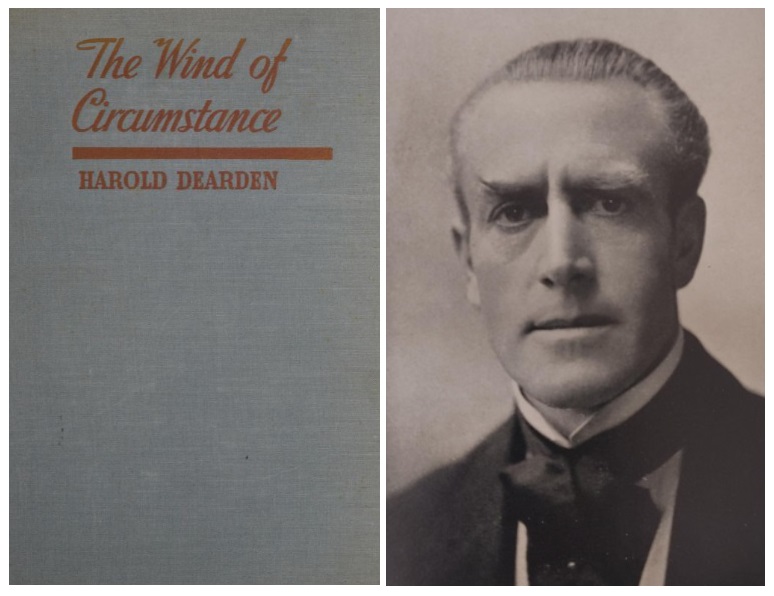
The only known (to me) in existence first hand account of a professional puncing match after the Lancashire fashion (yes, it was a legitimate sport, at least in Bolton, where betting playing an important role) is given in Chapter 36 of “The Wind of Circumstance” (1938), a biographical book written by a native Boltonian, the author called Harold Dearden (1882-1962).
“One Saturday morning during the holidays, while I was cleaning my pony’s harness in the stable-yard (it was one of my father’s theories that a properly educated person should be able to do anything) old Joe came up to see me with a broad grin on his rosy, clean-shaven face.
‘Ave ye ever seen a puncin’ match, Master ‘arold? he said, punce being our Lancashire synonym for a kick. I admitted that I had not. There was one coming off that afternoon, he told me then, at a “pub”; on the moors within a hour or two’s walking distance. I said I would like to see it immensely, so shortly after lunch we set off together.” (Chapter 35).
The Dearden’s story not only confirmed the words of Tattersall and Shorrocks, it has provided a very detailed and vivid description of the combat itself.
And these are the highlights of how the rules, according to which the clog business was done in the vicinity of Bolton in the 1800s, provided by an actual witness of the puncing match. Apparently the combatants (obviously two local miners) appeared “naked except
for the breeches and clogs”, and “each put his hands on the shoulder of the other, the left hand inside and the right hand outside the arm of his opponent,” which was known as a “fair grip.” The contestants had to keep each other at arms length throughout the fight, and it is from that grip the fall was given. The match was conducted in rounds and “a round only ended when a man fell.” It was not necessarily the number of won rounds that gave victory to a certain fighter, but it more mattered who won the “last fall” to make the opposite party quit the contest. In the case of both fighters unwilling to continue the fight it was then that the score mattered.
According to Dearden it “was a foul to kick above” the knee. Not only was it allowed to adjust and improve the initial hold during the fight, the competitors also had the freedom of shifting to another hold as long as they kept their opponent at arms length; even clasping hands behind the opponent’s neck. Bearing all weight on the back of an opponent’s neck was also an approved clog-fighting technique! This fact leaves no doubts that the original proper name of Lancashire’s puncing game was traditional English wrestling at arms’ length!
This is all for now, I am very happy to share with everyone this study which took so many years for me to finish. All the credit for the final success of this research rightfully belongs to the Dearden’s book account of a puncing match, The account of the match finally shed light on the obscure and mysterious roughest sport of this toughest of races. I wish everyone patience similar to the one I had to continue this struggle for historical truth and happy reading…and happy puncing!
28827
Page added 29/08/2026

